Description
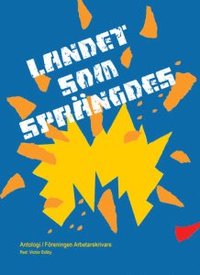
We live in an age when class divisions in society are widening, with inequality and child poverty on the rise. People speak of an inevitable trend driven by the market and globalisation. But it is a matter of political decisions that are fuelling this trend. Talking about class differences is still relevant. In politics, there is talk of how important a working population is. Yet it is often claimed that there is no working class, and there is a perception that workers do not exist. But someone collects your rubbish, someone builds your house, someone cooks your food in the restaurant, someone manufactures your medicine, someone looks after your elderly father or grandmother. Workers do exist. And the Workers’ Writers’ Association exists. We put into words the world we live in, we depict the trends in society, we scrutinise the direction we are heading. Sweden has a proud tradition of writers and storytellers who have emerged from the working class, many so-called ‘self-taught writers’. Writers who have attended the university of life. Storytellers who write from a grassroots perspective. The book you hold in your hand is a continuation of that tradition and the association’s eighth anthology. The previous one, Skarpt läge, published in 2010, was a great success and was praised for its high quality. ‘Everything exciting is to be found among the working class,’ Ivar Lo-Johansson once said. We believe that this is still true, that our experiences are interesting. Bringing them to life in literature fulfils an important function. Ivar Lo-Johansson’s work helped to change Sweden. His depictions of farm labourers’ conditions hastened the abolition of the farm labourer system. Ove Allansson, who contributes to this collection, wrote about the conditions of seafarers in his novel *Ombordarna*. That story led to three parliamentary motions. Elsie Johansson worked at the Post Office in Uppsala when, at the age of 48, she made her debut with a collection of poems and was later highly acclaimed for her trilogy of novels about the girl Nancy and the Tåpelle family. Drawing on a long working life in a female-dominated workplace, she combines solidarity and insight into human nature in her writing and is a major source of inspiration for working-class writers. Recently, the texts and books of the association’s members, as well as working-class literature, have received increasing attention and are being discussed and debated more and more.We believe in the power of culture and literature, and we see a country that is being torn to pieces. Yet we still hold out hope that a better world is within reach. That our words matter. Drawing on our experiences of society, we can give a voice to the vulnerable. There are many of us, and we write in various genres. We tell stories about people’s work and everyday lives. The Country That Was Torn Apart is our contribution. Åke Johansson, Chair of the Workers’ Writers’ Association